
Discover what a senior full stack developer actually delivers for small businesses and startups, from system reliability to scalable architecture and real business outcomes.
Senior full stack developer: the results that matter

TL;DR:
- Senior full stack developers own project outcomes and oversee the entire development lifecycle.
- They design scalable, secure systems that anticipate failure, reducing long-term costs and rework.
- Their evolving role includes managing AI integration, mentorship, and strategic decision-making for business growth.
Hiring a developer feels straightforward until the project stalls, the site breaks under load, or the feature you needed last month still isn’t live. Many small businesses and startups discover too late that not all developers are equal. The gap between a mid-level developer and a senior full stack developer isn’t just about years of experience. It’s about ownership, judgement, and the ability to translate technical decisions into real business outcomes. This article breaks down what a senior full stack developer actually does, why it matters for your business, and how to make smarter hiring decisions from the outset.
Table of Contents
- What makes a developer ‘senior’: Skills and responsibilities
- Technical mastery: Designing robust and scalable systems
- Business impact: How seniors streamline operations and outcomes
- Leadership, mentoring and the future: AI, team enablement, and evolving senior roles
- Why small businesses need senior full stack developers: A fresh perspective
- Ready to elevate your business? Connect with a senior developer
- Frequently asked questions
Key Takeaways
| Point | Details |
|---|---|
| End-to-end ownership | Senior full stack developers oversee the entire digital lifecycle, from architecture to deployment, ensuring reliability and scalability. |
| Small business impact | Versatile senior developers streamline operations and enable cost-effective growth, crucial for startups and lean teams. |
| Technical and business balance | They blend technical mastery with business outcomes, handling edge cases, security, and mentoring. |
| Adaptability in evolving tech | With automation rising, seniors focus on system design, strategic thinking, and team enablement. |
What makes a developer ‘senior’: Skills and responsibilities
The word ‘senior’ gets used loosely in the industry. Job boards are full of developers who call themselves senior after three years and a few React projects. But genuine seniority is something quite different.
A senior full stack developer oversees the entire web development lifecycle, covering front-end interfaces, back-end logic, database design, third-party integrations, security, and deployment. That breadth matters enormously for small businesses and startups, where you rarely have the luxury of a specialist for every layer of the stack.
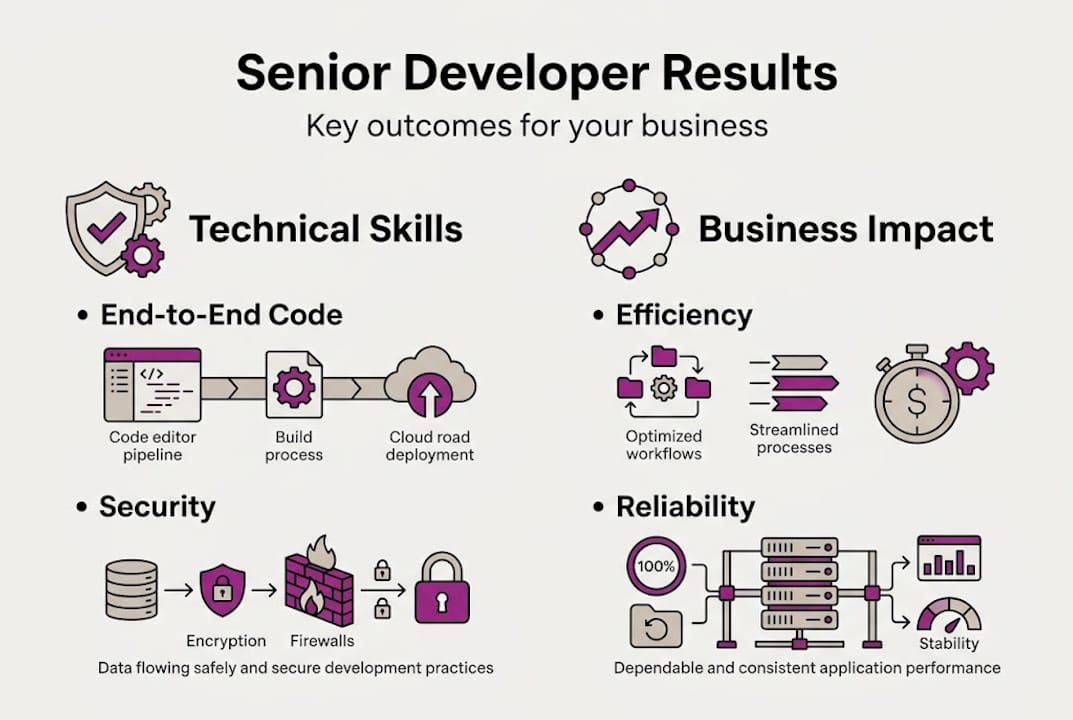
Mid-level developers complete tasks. Senior developers own outcomes. That distinction shapes everything from how a project is scoped to how it holds up six months after launch.
Some of the hallmarks that separate a senior developer from the rest include:
- Anticipating failure modes before they become incidents
- Designing for scalability so the system grows with your business
- Saying no to technically poor ideas, even when the client wants them
- Mentoring junior team members without creating bottlenecks
- Owning the consequences of architectural decisions, not just the code
These expert nuances are what separate someone who writes good code from someone who builds reliable systems.
| Capability | Mid-level developer | Senior full stack developer |
|---|---|---|
| Task completion | Completes assigned work | Defines and owns the work |
| System thinking | Feature-focused | Architecture-focused |
| Risk awareness | Reacts to problems | Anticipates and prevents them |
| Communication | Technical peers | Non-technical stakeholders too |
| Mentoring | Receives guidance | Provides guidance |
| Business alignment | Limited | Central to decision-making |
Pro Tip: When evaluating developers, map their skills to your business needs rather than just ticking technical boxes. Ask how they’ve handled a project that went wrong. The answer tells you more than any CV.
For small businesses, having someone who understands web system architecture and applies secure deployment practices from day one prevents the expensive rework that comes from building on shaky foundations. And if you ever grow a team, the ability to start mentoring teams is already built in.
Technical mastery: Designing robust and scalable systems
Technical mastery isn’t about knowing every framework. It’s about understanding systems deeply enough to make the right trade-offs under real-world constraints.
Senior full stack developers think in terms of reliability and predictability. They know that reliable systems matter more than elegant code alone, and that business constraints, team capability, and long-term maintainability must shape every technical choice.
Here’s where this becomes practical. Common pitfalls that junior and mid-level developers routinely miss include:
- N+1 query problems: Fetching data in loops rather than batching, causing databases to buckle under load
- Poor caching strategies: Serving stale data or hammering the database unnecessarily
- Inadequate error handling: Failing silently instead of surfacing actionable information
- Type-unsafe designs: Allowing bugs to slip through that a stricter approach would catch at compile time
Seniors address these through robust error handling, including idempotency, distinguishing retryable from non-retryable failures, cache invalidation strategies, cursor-based pagination, and type-safe design patterns.
| Technical competency | Why it matters for your business |
|---|---|
| Scalable architecture | Your site handles growth without expensive rewrites |
| Security hardening | Customer data stays protected from common vulnerabilities |
| Error handling | Problems surface early, reducing downtime |
| Database optimisation | Pages load faster, reducing bounce rates |
| API integration | Third-party tools connect reliably without breaking |
For context on pay, senior full stack developers in the UK typically command significantly higher day rates than mid-level counterparts, reflecting the reduced risk and greater output they deliver.
Pro Tip: During any developer interview or discovery call, ask directly: “How do you approach edge cases and failure scenarios?” A senior developer will have a structured answer. Someone less experienced will talk about testing after the fact.
Applying security best practices from the architecture stage, rather than bolting them on later, is one of the clearest signs of senior thinking. If you’re interested in launching scalable digital solutions, understanding this distinction will save you considerable time and money.
Business impact: How seniors streamline operations and outcomes
Beyond the technical side, the real question for any small business owner is simple: what do I actually get?
For startups and small businesses, a senior full stack developer offers versatility across overlapping roles, enabling rapid prototyping, end-to-end project ownership, and cost-effective scaling without the overhead of a large team. That’s a significant advantage when budgets are tight and speed matters.
Here’s how a senior developer typically moves a project from idea to outcome:
- Discovery and scoping: Translating business goals into a technical plan, identifying risks before a line of code is written
- Architecture design: Choosing the right tools and structure for the problem, not just the most fashionable ones
- Build and iteration: Delivering working software in stages, with feedback loops built in
- Testing and hardening: Stress-testing the system against real-world conditions, not just happy paths
- Deployment and monitoring: Launching with confidence and watching for issues in production
- Documentation and handover: Leaving the codebase in a state that others can maintain and build on
“Hiring a senior full stack developer for a startup isn’t a luxury. It’s the fastest route to a system that works, scales, and doesn’t need rebuilding in twelve months.”
The benefits for startups are concrete. Seniors handle the full stack independently, implement scalable and security-focused solutions quickly, and mentor any team members brought on later.
Additional ways seniors accelerate small business outcomes include:
- Reducing time-to-launch through confident, decisive technical choices
- Cutting long-term costs by avoiding technical debt from the start
- Improving reliability, which directly protects revenue and reputation
- Communicating clearly with non-technical stakeholders, reducing misunderstandings
Exploring streamlining digital solutions or enhancing your online presence becomes far more achievable when the person leading development thinks in business outcomes, not just code.
Leadership, mentoring and the future: AI, team enablement, and evolving senior roles
Seniority isn’t static. The expectations placed on senior developers are shifting, and understanding this helps you hire for the next three years, not just the next three months.
The most immediate shift is around AI. Some see AI tools automating junior-level tasks, which raises the bar for what a senior developer must provide: deeper domain knowledge, stronger architectural judgement, and strategic thinking that AI cannot replicate. Others point out that cheaper code generation actually increases demand for senior oversight, because more custom solutions become viable for small businesses, and someone needs to ensure they’re built correctly.
Both views point to the same conclusion. The value of a senior developer is shifting further towards system ownership and leadership in development teams rather than raw output.
The evolving responsibilities of senior developers now include:
- Reviewing AI-generated code for correctness, security, and maintainability
- Setting architectural standards that junior developers and AI tools work within
- Domain expertise that contextualises technical decisions within a specific industry
- Stakeholder communication that bridges the gap between business strategy and technical execution
- Mentoring teams to work effectively alongside AI tools without losing quality control
Seniors who anticipate failure modes and design for maintainability are the ones who will remain indispensable as the tooling landscape changes.
Pro Tip: When evaluating a senior developer’s leadership capability, ask how they’ve upskilled a less experienced colleague or reviewed someone else’s work. Strong leaders can describe specific examples, not just general principles.
If you want to understand the future of full stack roles or how building a developer portfolio reflects these evolving standards, both are worth exploring as the industry continues to shift.
Why small businesses need senior full stack developers: A fresh perspective
There’s a persistent myth in small business hiring: that clean, well-written code is the primary measure of a good developer. It isn’t.
The businesses that get the best results from their development investment aren’t the ones who hired the developer with the tidiest GitHub profile. They’re the ones who hired someone who understood their constraints, prioritised reliability over cleverness, and made decisions that held up under real pressure.
Senior developers prioritise predictability, business constraints, and team enablement over aesthetic code quality. That’s not a compromise. That’s exactly what a growing business needs.
The real cost of hiring someone too junior isn’t the lower day rate. It’s the rework, the downtime, the missed edge cases, and the system you have to rebuild eighteen months later. Senior talent doesn’t just deliver better code. It multiplies the effectiveness of every business decision that depends on your digital infrastructure.
If you’re launching with senior developers from the start, you’re not spending more. You’re spending once.
Ready to elevate your business? Connect with a senior developer
If this article has shifted how you think about development hiring, the next step is straightforward. Rich Harrington brings over 22 years of hands-on senior full stack experience to businesses that need reliable, scalable, and well-considered digital solutions.

Whether you’re starting from scratch or untangling a system that’s grown beyond its original design, the senior developer services at richharrington.dev are built around your outcomes, not just your brief. Explore custom development solutions tailored to small businesses and startups, or review past project examples to see the kind of work that’s already been delivered. A conversation costs nothing and could save you considerably more.
Frequently asked questions
What defines a senior full stack developer for small businesses?
A senior full stack developer takes end-to-end ownership of projects, covering front-end, back-end, security, and deployment, while anticipating issues before they occur. For small businesses, this means fewer surprises and a system that actually scales.
How do senior developers prevent costly mistakes?
They design for robust error handling from the start, addressing edge cases, cache invalidation, and type-safe patterns that prevent bugs reaching production. Prevention is always cheaper than fixing.
Why invest in a senior developer instead of hiring multiple juniors?
A senior offers versatility across overlapping roles, delivering reliable and scalable solutions independently without the coordination overhead that comes with managing multiple less experienced developers.
How is the role of senior developers changing with AI?
AI is automating junior-level tasks, which raises the bar for seniors to provide deeper domain knowledge, stronger architectural judgement, and strategic oversight that tools alone cannot supply.
Recommended
- The Future of Full-Stack Development | Rich Harrington
- Why a great developer portfolio brings clients to your door | Rich Harrington
- Rich Harrington | Full-Stack Developer & WordPress Expert
- Services | Rich Harrington - Full-Stack Developer
- Carbon Construct Omaha Website Launch: From Abandoned Project to Live in 2 Days - MonsterWP