Learn how to hire the right developer for your digital project. This step-by-step guide covers scoping, sourcing, screening, and making a confident final decision.
How to hire a developer for custom digital projects

TL;DR:
- Clarify project needs to match the right developer type and essential skills.
- Use targeted sourcing methods and evaluate portfolios to find high-quality candidates.
- Conduct structured screening, practical trial projects, and thorough reference checks before hiring.
You have a clear vision for your website or app. You know what it needs to do, and you know it matters for your business. The problem is finding a developer you can actually trust to build it properly, on time, and without doubling your budget halfway through. Hiring the wrong person costs far more than money. It costs momentum. This guide walks you through every stage of the process, from scoping your requirements and knowing where to search, to screening candidates, running interviews, and making a confident final decision.
Table of Contents
- Clarify your project needs and define the right developer profile
- Where and how to find high-quality developer candidates
- How to screen applicants and shortlist the best developers
- Interviewing, trial projects, and making the final hiring decision
- What most hiring guides get wrong—and what actually works
- Ready to hire your next great developer?
- Frequently asked questions
Key Takeaways
| Point | Details |
|---|---|
| Define your needs clearly | A focused project brief helps match you with the right developer. |
| Screen and shortlist carefully | Structured screening prevents wasted time and poor hires. |
| Use trial projects | Paying for a small test task lowers risk and reveals real expertise. |
| Prioritise communication and fit | Technical skills matter, but working style and reliability are just as important. |
Clarify your project needs and define the right developer profile
Before you post a single job listing or send one message on LinkedIn, you need to be clear on what you are actually building. Vague briefs attract vague developers. Specific ones attract the right ones.
Start by asking yourself a handful of direct questions: What problem will this solution solve for my customers or team? Which features are absolutely critical, and which are nice to have later? Does this need to connect with any existing systems or third-party tools? Will it need ongoing maintenance, or is it a one-off build? Writing down honest answers to these questions will shape every decision that follows.
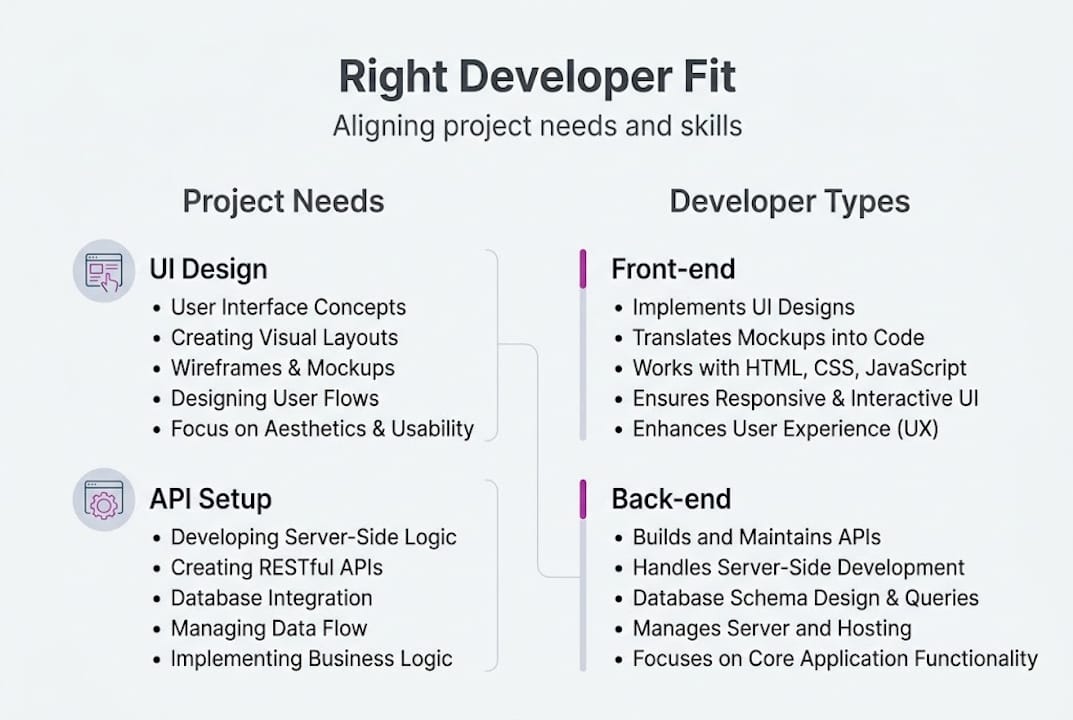
With that clarity in place, you can identify the type of developer your project actually needs. Not every project requires the same skill set.
| Developer type | Best suited for |
|---|---|
| Front-end developer | Visual design, UI, browser interactions |
| Back-end developer | Server logic, databases, APIs |
| Full stack developer | End-to-end builds requiring both front and back-end |
| WordPress developer | CMS-based sites, themes, plugins, WooCommerce |
| SaaS developer | Subscription platforms, multi-tenant apps |
Matching developer skills to project goals measurably increases hiring success, which is why this scoping step saves you time and money before the search even begins.
When you have a developer type in mind, build your skills list. Split it into two categories:
Must-have skills:
- JavaScript or TypeScript for interactive front-ends
- PHP or Node.js for server-side logic
- REST API integration experience
- Version control with Git
- Familiarity with responsive design principles
Nice-to-have skills:
- UX/UI basics and an eye for usability
- Experience with cloud platforms such as AWS or Vercel
- Knowledge of performance optimisation and accessibility standards
- Familiarity with your industry or sector
When reviewing developer portfolios, look beyond the visual finish. Does the work show genuine problem-solving? Does the developer appear to understand what each project was trying to achieve commercially?
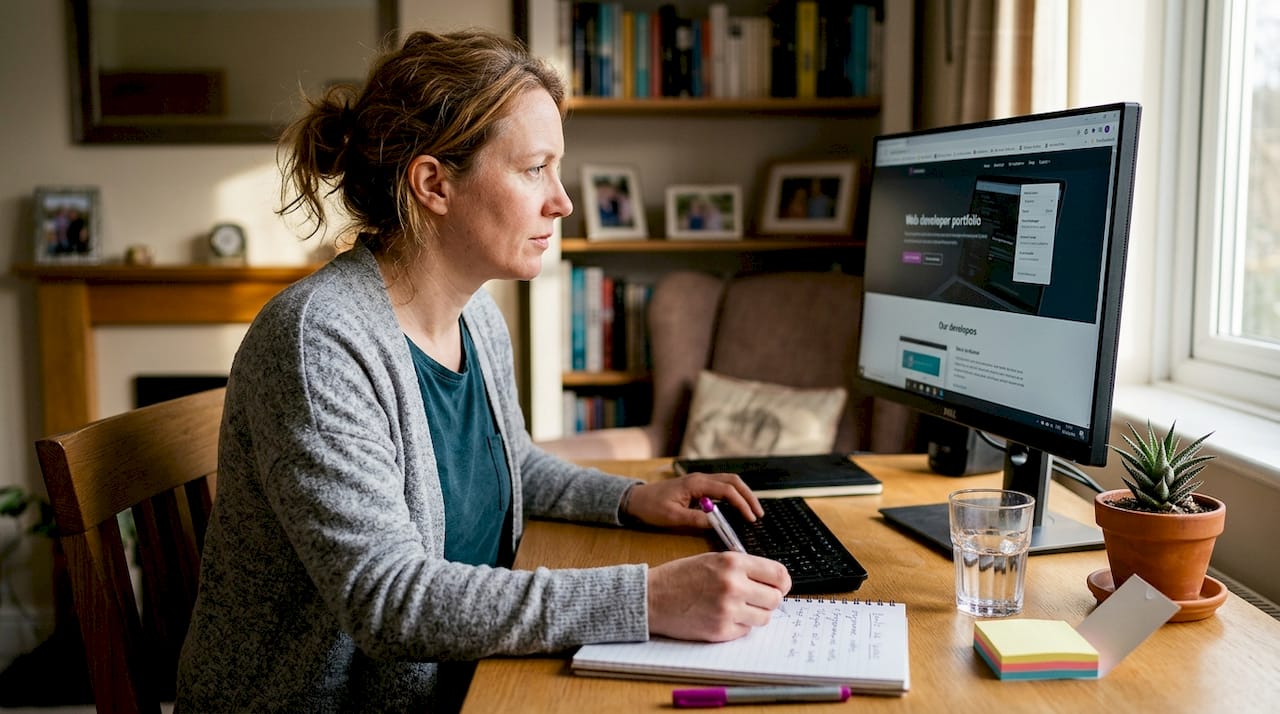
Pro Tip: Prioritise developers who ask about your business goals before diving into the technical details. That curiosity is a strong early signal of someone who will build something that actually works for you, not just something that technically functions.
Where and how to find high-quality developer candidates
With a clear sense of your project’s scope and requirements, it is time to start your search. The developer market is large, but the genuinely reliable slice of it is smaller than you might expect. Knowing where to look makes all the difference.
The best sources for finding skilled developers include:
- Specialist job boards such as Stack Overflow Jobs, GitHub Jobs, and We Work Remotely, which attract developers actively looking for new work
- Professional referrals from people in your network who have successfully hired developers before
- Development communities on Slack, Discord, and Reddit where active practitioners discuss real projects
- LinkedIn, filtered by specific skills, location, and recent activity
- Portfolios and personal sites, which signal initiative and a pride in craft
Utilising multiple sourcing platforms broadens the talent pool and reduces the risk of settling for the first available candidate. You can find additional talent acquisition tips to support a more structured approach to your search.
When evaluating where to source, it also helps to understand the trade-offs between different hiring models.
| Hiring model | Pros | Cons |
|---|---|---|
| Freelancer | Flexible, cost-effective, fast to start | Variable availability, less accountability |
| Agency | Structured process, team support | Higher cost, less direct communication |
| In-house hire | Full control, long-term investment | Higher overhead, slower to onboard |
For most small business owners running bespoke digital projects, a skilled freelancer or independent senior developer sits in the ideal middle ground. Keeping up with full stack development trends can also help you recognise which technical approaches are current and which are becoming obsolete.
Pro Tip: For SME projects involving WordPress or SaaS builds specifically, look for developers with niche experience in those environments rather than generalists. Specialist knowledge here often means fewer integration surprises and faster delivery.
How to screen applicants and shortlist the best developers
After gathering a pool of potential candidates, you need to separate the good from the great. Screening is where most hiring decisions are actually won or lost, yet many small business owners rush this stage.
Follow a structured process to keep things objective:
- Review the portfolio thoroughly. Look for projects similar to yours in complexity or industry. Check whether outcomes are mentioned, not just screenshots.
- Assess technical expertise. Does the candidate demonstrate current knowledge? Are they familiar with the tools your project requires?
- Check references and testimonials. A developer with genuine client recommendations is a significantly safer bet than one relying solely on self-promotion.
- Shortlist to three to five candidates. More than this creates decision fatigue. Fewer limits your comparison.
Structured screening lowers the risk of bad hires considerably, and this step is worth every hour it takes. For more complex requirements, developer assessment support can help you evaluate candidates more objectively.
When reviewing a portfolio, set yourself a simple task: identify one project where the developer clearly made a decision that benefited the end user or client commercially, not just technically. If you cannot find evidence of that kind of thinking, move on.
“The best developers communicate clearly, respond promptly, and flag problems early. If a candidate is already vague or slow during the application stage, that behaviour rarely improves once they are on your project.”
Watch for these red flags during screening:
- Vague portfolios with no detail about the developer’s actual contribution
- No references or testimonials, especially for developers claiming significant experience
- Poor communication at the initial contact stage
- Overloaded CVs padded with every tool ever touched, rather than focused relevant experience
Be aware of essential interview questions worth preparing before you move to the interview stage, as these will help you extract much more useful information from the shortlisted candidates.
Interviewing, trial projects, and making the final hiring decision
Once you have created a shortlist, it is time to put candidates to the test and make the final call. This stage requires preparation on your side too.
Follow these steps to run the process well:
- Prepare a mix of technical and soft-skill questions. Ask about specific projects, how they handled scope changes, and how they communicate with non-technical stakeholders.
- Plan a follow-up technical task. This does not need to be elaborate. A focused problem relevant to your project is far more useful than an abstract coding puzzle.
- Use the remote interviewing guide for structuring remote sessions, which is particularly relevant if you are hiring outside your local area.
- Make your decision using a simple scorecard. Rate each candidate across four areas: technical ability, communication, relevant experience, and cultural fit.
Trial projects provide valuable evidence of real-world skills that no CV or interview alone can replicate.
Pro Tip: Always commission a small paid trial task before making a final commitment. Pay fairly for the work, keep it realistic and bounded, and treat the output as data. How a developer handles a modest brief tells you a great deal about how they will handle your full project.
Before you sign anything, complete these final due diligence steps:
- Contact at least two references and ask specific questions about reliability and communication
- Clarify project timelines, milestone expectations, and how revisions will be handled
- Draft a simple written agreement covering scope, payment terms, and intellectual property ownership
- Agree on your preferred communication tools and check-in frequency from day one
When evaluating developer portfolios one final time before sign-off, ask whether the work genuinely reflects the kind of output your project demands.
What most hiring guides get wrong—and what actually works
Most guides treat developer hiring as a purely technical screening exercise. They tell you to test for syntax knowledge, run timed coding challenges, and check for specific framework experience. With over 22 years building for the web, I can tell you that approach misses the point more often than not.
The developers who consistently deliver are the ones who understand your goals, communicate honestly about problems, and adapt when requirements shift. Those qualities do not show up in a timed test. Automated coding challenges in particular tend to filter out thoughtful, pragmatic developers in favour of those who are good at performing under artificial pressure.
For custom SaaS hiring experience and bespoke digital projects, fit matters as much as skill. Can this person explain a technical decision in plain English? Do they ask questions that show genuine interest in your business outcome?
Hire for curiosity, adaptability, and honest communication. Those traits, combined with solid technical experience, produce far better results than a perfect score on a technical test ever will.
Ready to hire your next great developer?
If you are ready to put these strategies to use, expert guidance and support are just a click away.
Rich Harrington brings over 22 years of hands-on full stack development experience to every project, working directly with small businesses and entrepreneurs to build reliable, well-crafted digital solutions. From bespoke web applications to WordPress builds and API integrations, the full range of developer services is built around what growing businesses actually need. Browse past client work to see the quality for yourself, then book a consultation to talk through your project with no obligation. Getting started is straightforward, and the right developer could be closer than you think.
Frequently asked questions
What questions should I ask a developer before hiring?
Effective questions uncover both technical and interpersonal qualities, so ask about project experience, approach to deadlines, and specific problems they have solved in past work.
How long does it usually take to hire a developer?
With a focused search and structured screening, typical hiring timelines for skilled developers run between two and six weeks for most small business projects.
Should I work with a freelancer, agency, or in-house developer?
For most small bespoke projects, freelancers offer flexibility and lower cost, though comparing freelance, agency, and in-house options reveals that agencies or in-house developers suit more complex, ongoing needs better.
What is the best way to test a developer’s real skills?
Set a small paid trial project that mirrors a realistic task from your actual build. Trial projects provide useful skill evidence that interviews alone cannot match.