Learn what full stack development is, which technologies matter, and how to hire the right developer to grow your business online. Practical, jargon-free guide.
Full stack development explained: boost your business online

TL;DR:
- Full stack development allows a single developer to handle all website layers, saving costs.
- Choosing the right technology stack depends on your project’s needs and team skills.
- True expertise lies in broad knowledge with deep skills in key areas, not in claiming mastery of all technologies.
Most small business owners assume that building a serious web platform means hiring a front-end designer, a back-end engineer, a database administrator, and a DevOps specialist. That assumption is expensive and, in many cases, completely unnecessary. Over 35% of developers now identify as full stack, meaning a single skilled developer can handle the entire build from interface to infrastructure. This article breaks down what full stack development actually means, which technologies matter, how reliable workflows are structured, and what risks to watch for. By the end, you will have a clear picture of whether a full stack approach is right for your business.
Table of Contents
- What is full stack development?
- Core technologies and popular stacks
- Full stack workflows and methodologies
- Challenges, risks, and expert solutions
- Why the myth of the full stack ‘master’ is misleading
- Unlock reliable full stack expertise for your business
- Frequently asked questions
Key Takeaways
| Point | Details |
|---|---|
| Full stack covers all layers | Full stack development spans frontend, backend, databases, and deployment for a seamless web solution. |
| Business benefits | Hiring a full stack developer reduces costs and accelerates MVP launches for startups and small businesses. |
| Popular stack choices | Common stacks like MERN, MEAN, and LAMP help streamline development depending on project requirements. |
| Vet for depth, not breadth | Choose developers with deep expertise in one or two areas plus broad stack knowledge for reliability. |
| Smart hiring avoids risk | Relying solely on ‘jack of all trades’ invites key-person risk; opt for T-shaped skillsets and proven experience. |
What is full stack development?
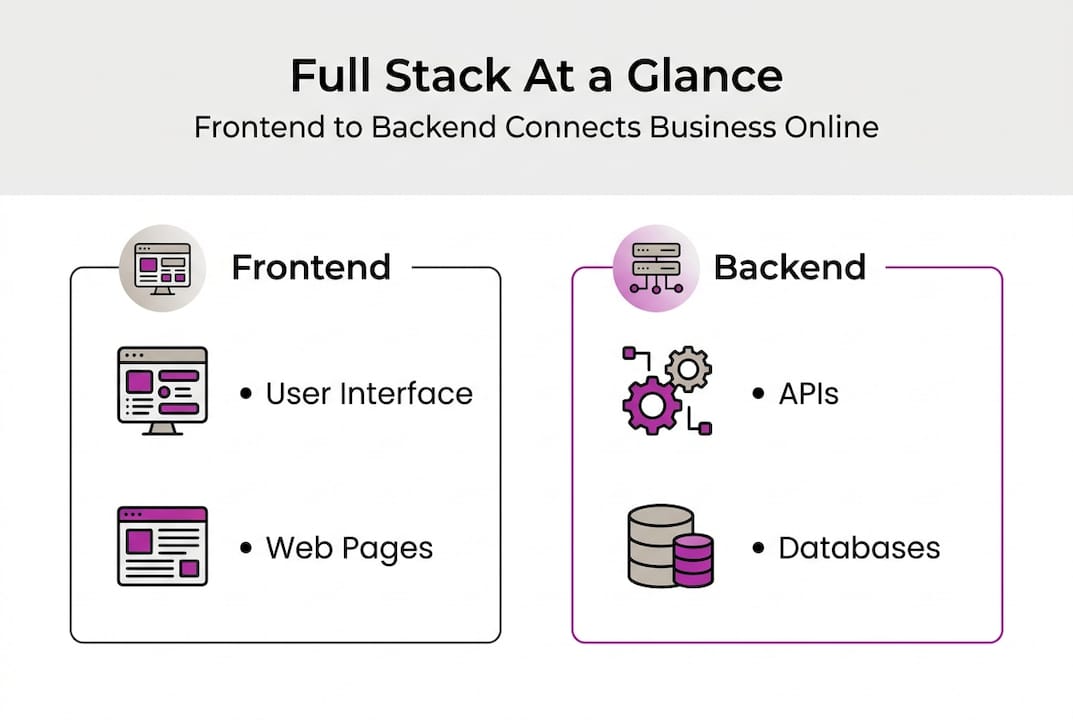
Full stack development is the practice of building both the visible parts of a website or application and the hidden logic that powers it. Client-side and server-side work are both within scope, which means one developer can own the entire product rather than passing work between specialists.
Think of it like a general contractor on a building site. They do not personally lay every brick, but they understand plumbing, electrics, and structure well enough to coordinate the whole job and step in where needed. A full stack developer works in the same way, moving across layers of a project with enough depth to make good decisions at every level.
For a small business or startup, that breadth translates directly into savings. You are not paying for handoffs between teams, not waiting for a back-end developer to implement something a front-end developer designed, and not managing three separate contractors on one project.
Here is what full stack development typically covers:
- Frontend: Everything a user sees and interacts with, built using HTML, CSS, and JavaScript frameworks
- Backend: Server logic, authentication, business rules, and APIs that process requests
- Database: Structured storage and retrieval of data, using SQL or NoSQL solutions
- Deployment: Hosting, cloud infrastructure, domain configuration, and ongoing maintenance
| Layer | What it does | Example tools |
|---|---|---|
| Frontend | User interface and experience | React, Vue, HTML/CSS |
| Backend | Server logic and APIs | Node.js, PHP, Python |
| Database | Data storage and retrieval | PostgreSQL, MongoDB |
| Deployment | Hosting and infrastructure | AWS, Vercel, Docker |
Pro Tip: If you are launching an MVP (minimum viable product), a full stack developer can take you from zero to live faster than any agency team, because there is no communication overhead between layers.
“A full stack developer is someone who can work on both the front-end and back-end portions of an application.” This holistic ownership is what makes the model so valuable for lean teams.
Explore the range of full stack services available if you want to understand what this looks like in practice for a real business engagement.
Core technologies and popular stacks
Now that the scope is clear, it helps to understand the specific tools involved. The phrase “tech stack” simply refers to the combination of technologies used to build a product. Different stacks suit different business needs, and choosing the wrong one early can create expensive problems later.
Key technologies across the full stack include HTML, CSS, JavaScript, React, Angular, Node.js, Python, PHP, SQL, and NoSQL databases. That list covers most of what you will encounter in a modern web project.
Here are the three most common stacks and what they are best suited for:
- MERN (MongoDB, Express, React, Node.js): Ideal for dynamic, data-heavy applications and startups that need to move fast. JavaScript runs on both front and back end, which simplifies the codebase.
- MEAN (MongoDB, Express, Angular, Node.js): Similar to MERN but uses Angular instead of React. Angular is more opinionated, which can be useful when consistency across a large team matters.
- LAMP (Linux, Apache, MySQL, PHP): A battle-tested stack that powers a huge proportion of the web, including most WordPress installations. Reliable, well-documented, and widely supported.
| Stack | Best for | Maturity |
|---|---|---|
| MERN | Startups, SPAs, real-time apps | Modern |
| MEAN | Enterprise apps, large teams | Modern |
| LAMP | CMS, e-commerce, content sites | Established |
Pro Tip: Do not let a developer choose a stack because it is fashionable. The right stack is the one that fits your budget, your team’s skills, and your product’s long-term needs.
Stack choice also affects hiring. If your developer builds on an obscure framework, finding someone to maintain the project later becomes harder and more expensive. Sticking with widely adopted technologies protects your investment.
If you are curious about where these technologies are heading, the future of full stack is worth reading before you commit to a technology direction.
Full stack workflows and methodologies
Knowing which technologies exist is only part of the picture. How a developer works, the processes they follow and the tools they use to manage delivery, matters just as much for your business outcome.
Agile, Scrum, CI/CD, version control, containerisation, and cloud deployment are the methodologies that underpin reliable full stack delivery. These are not buzzwords. They are practical systems that reduce errors, speed up releases, and make your project easier to maintain.

Full stack workflows typically span planning, UI/UX design, API development, database design, testing, and monitoring. Each phase feeds into the next, and skipping any of them creates problems downstream.
Here is what a well-run full stack workflow looks like in practice:
- Version control (Git): Every change is tracked, reversible, and documented. You will never lose work to an accidental overwrite.
- CI/CD pipelines: Continuous integration and continuous deployment automate testing and releases, so updates go live quickly and safely.
- Cloud deployment: Platforms like AWS, Google Cloud, or Vercel handle scaling automatically, so your site stays fast even when traffic spikes.
- Automated testing: Unit tests, integration tests, and end-to-end tests catch bugs before they reach your users.
- Monitoring and alerting: Tools like Sentry or Datadog flag errors in real time, so problems are fixed before customers notice them.
For startups building their first product, these workflows are especially valuable. A small team with good processes can outperform a large team without them. If you are considering a custom SaaS development project, these workflows are non-negotiable. For simpler requirements, a well-structured website development engagement follows the same principles at a smaller scale.
Challenges, risks, and expert solutions
Full stack development is powerful, but it is not without risk. Understanding where things go wrong helps you ask better questions and make smarter hiring decisions.
Common edge cases in full stack work include N+1 query problems, security boundary failures, state management errors, poor error handling, and performance degradation under load. Each of these can silently damage your product and your reputation if left unaddressed.
Here is what to watch for:
- N+1 queries: A database fetching hundreds of individual records instead of one efficient query. This kills performance at scale.
- Security boundaries: Failing to validate input on the server side, even when it is validated on the client side, opens you to attacks.
- State management: Poorly managed application state leads to bugs that are difficult to reproduce and expensive to fix.
- Error handling: Applications that fail silently frustrate users and make debugging nearly impossible.
True full stack mastery is rare; T-shaped profiles with deep expertise in specific areas are what you should actually be looking for. A T-shaped developer has broad knowledge across the stack and genuine depth in one or two layers. That combination is far more reliable than someone who claims equal mastery of everything.
Pro Tip: When vetting a full stack developer, ask them to walk you through a past project’s architecture. Depth of explanation reveals depth of understanding far better than a list of technologies on a CV.
AI tools are changing this landscape too. Developers who use tools like GitHub Copilot or Cursor can move faster across unfamiliar layers, but AI does not replace sound judgement on security, architecture, or testing. For projects where data protection matters, dedicated security hardening should be part of your brief from day one. For a broader view of best practices, BrowserStack’s full stack guide is a useful external reference.
“The best developers are not those who know every tool, but those who know which tool to reach for and why.”
Why the myth of the full stack ‘master’ is misleading
After 22 years building for the web, one pattern stands out clearly. The developers who claim to be equally expert in every layer of the stack are usually the ones you should be most cautious about. Genuine expertise is specific. It is earned through repeated exposure to real problems, not through listing every framework on a profile page.
True full stack mastery is rare; what you actually want is broad knowledge paired with specific depth. A developer who is genuinely strong in React and Node.js, competent in database design, and comfortable with cloud deployment is far more valuable than someone who claims to be an expert in all twelve technologies they have listed.
For startups, this matters because your early technical decisions are the hardest to undo. Choosing a developer based on the length of their technology list rather than the quality of their reasoning is a costly mistake.
AI tools have made it easier for developers to work across more layers, and that is genuinely useful. But good architecture, thoughtful testing, and honest communication with non-technical stakeholders are still human skills. Prioritise those. Explore what future full stack skills look like as AI continues to reshape the industry.
Unlock reliable full stack expertise for your business
If this guide has clarified what full stack development involves and what to look for in a developer, the natural next step is finding someone who actually delivers on those standards.
Rich Harrington brings over 22 years of hands-on full stack experience to every project, working directly with business owners and founders who need reliable, clearly communicated development work. Whether you need a complete web build, an API integration, or an ongoing technical partner, the full stack development services on offer cover the full range. For product-focused founders, custom SaaS solutions are available with transparent pricing and no agency overhead.
Frequently asked questions
What exactly does a full stack developer do?
A full stack developer handles front-end and back-end coding, database management, and deployment, providing end-to-end ownership of a web application without requiring separate specialists for each layer.
How do I choose the right stack for my business?
Base your choice on project requirements, long-term maintenance needs, and developer availability. Popular stacks such as MERN, MEAN, and LAMP each suit different use cases, so match the technology to the problem rather than to trends.
Is full stack development suitable for rapid MVPs?
Yes. Full stack development is particularly well-suited to MVPs because a single developer can own the entire build. Rapid prototyping in startups and small businesses is one of the strongest use cases for this approach.
Are there risks in relying on full stack developers?
The primary risk is key-person dependency, where your entire technical knowledge sits with one individual. Mitigate this by choosing developers with T-shaped expertise and ensuring proper documentation and version control are in place from the start.
What is a T-shaped developer?
A T-shaped developer has broad skills with deep expertise in one or two specific areas. This profile is more reliable for real-world projects than a developer claiming equal mastery across every technology in the stack.
Recommended
- Services | Rich Harrington - Full-Stack Developer
- Rich Harrington | Full-Stack Developer & WordPress Expert
- Custom SaaS Development | Rich Harrington - Full-Stack Developer
- Web Design Swindon | Rich Harrington - Custom Website Development
- Step by Step Website Setup: Boost Local Traffic 60% in 2026
- UI and UX roles in web design: boost business growth