
Compare React, Vue, Angular, Svelte and SolidJS to find the right front end framework for your small business or startup web project in 2026.
Front end frameworks for efficient web development 2026

Not all front end frameworks are created equal, and choosing the wrong one can quietly cost your project months of rework. For small business web teams and startup developers, the sheer number of options, React, Vue.js, Angular, Svelte, SolidJS, can feel paralysing. Yet the decision shapes everything from page load speed to how easily a new developer can pick up your codebase six months down the line. This guide cuts through the noise, explains what each framework actually does, and gives you a practical framework for making the right call the first time.
Table of Contents
- What are front end frameworks and why do they matter?
- Comparing popular front end frameworks in 2026
- Performance and scalability: How frameworks shape outcomes
- Nuances, common pitfalls and practical selection advice
- Applying front end frameworks in real-world projects
- Connect with expert front end developers for your next project
- Frequently asked questions
Key Takeaways
| Point | Details |
|---|---|
| Frameworks optimize workflow | Front end frameworks streamline development, boost efficiency, and enhance maintainability. |
| Comparison reveals strengths | Each framework has unique strengths; matching them to project needs improves outcomes. |
| Performance matters for scale | Framework choice impacts speed, scalability, and the cost of long-term maintenance. |
| Common pitfalls exist | Understanding nuances and avoiding common mistakes helps ensure successful implementation. |
| Expert help accelerates success | Consulting with experienced developers can help small teams apply frameworks efficiently. |
What are front end frameworks and why do they matter?
A front end framework is a pre-built collection of tools, conventions, and reusable components that gives your user interface a structured foundation. Rather than writing every interaction from scratch, you work within a system that handles the repetitive parts, state management, DOM updates, routing, and component lifecycles, so you can focus on building features.
For small businesses and startups, this matters enormously. Without structure, codebases grow chaotic fast. One developer writes components one way, another writes them differently, and within a year you have a maintenance nightmare. Frameworks enforce consistency by design.
Popular frameworks in 2026 include React, Vue.js, Angular, Svelte, and SolidJS, each solving the same core problem with different philosophies. Understanding those differences is what separates a good technical decision from an expensive one. You can also explore how these tools fit into the future of full-stack development as the ecosystem continues to evolve.
Here is what frameworks deliver for small teams:
- Faster development cycles through reusable components and pre-built utilities
- Consistent code structure that makes onboarding new developers straightforward
- Optimised rendering that improves user experience without manual tuning
- Active ecosystems with libraries, plugins, and community support
- Scalability so your codebase grows without becoming unmanageable
Comparing popular front end frameworks in 2026
Having defined their function, we can now compare today’s most influential frameworks. Each has a distinct personality, and matching that personality to your project type is the real skill.
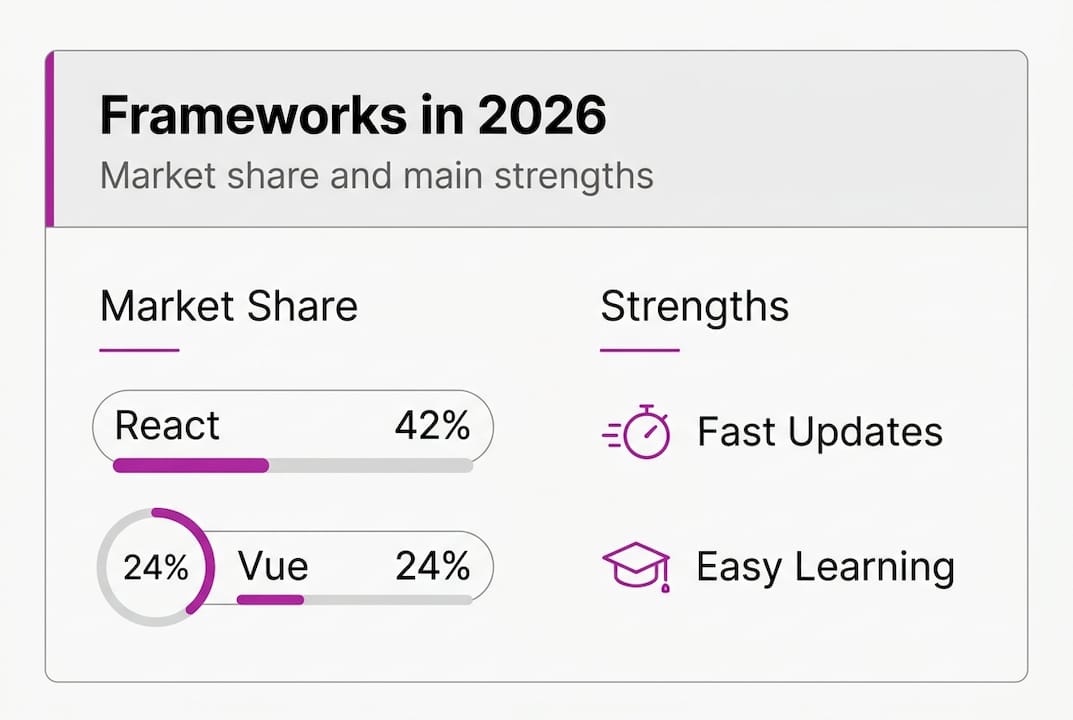
React holds 42.3% market share, with Vue at 23.8%, Angular at 9.2%, and Svelte at 8.1%. Stack Overflow surveys place React at 44.7% usage among professional developers. Those numbers tell a story about ecosystem maturity and hiring availability, both critical for small teams.
| Framework | Learning curve | Bundle size | Enterprise adoption | Best for |
|---|---|---|---|---|
| React | Moderate | Medium | Very high | SPAs, large apps |
| Vue.js | Low | Small | Moderate | Rapid prototyping |
| Angular | Steep | Large | High | Complex enterprise |
| Svelte | Low | Very small | Low | Performance-first |
| SolidJS | Moderate | Very small | Low | Speed-critical apps |
For a deeper look at how these three leading options stack up, the react vs vue vs svelte comparison breaks down the trade-offs in practical terms. You can also review benchmarking framework performance across real project scenarios.
When it comes to raw speed, framework performance benchmarks consistently show SolidJS and Svelte outperforming React and Angular in rendering tasks, though React’s ecosystem advantages often outweigh the raw speed gap for most projects.
For small teams, the essential factors to weigh are:
- Learning curve: Can your current team get productive quickly?
- Ecosystem size: Are there libraries for the integrations you need?
- Community adoption: Will you find answers when you hit problems?
- Long-term support: Is the framework actively maintained and growing?
Performance and scalability: How frameworks shape outcomes
Once the frameworks are compared, their real-world impact on speed and scalability becomes crucial. Performance is not just a technical metric. It directly affects bounce rates, conversion, and how users perceive your product.

Three metrics matter most: load time, bundle size, and runtime efficiency. Load time affects first impressions. Bundle size determines how much JavaScript the browser must parse before anything interactive appears. Runtime efficiency governs how smoothly the app responds once loaded.
| Framework | Initial load | Runtime score | Bundle size |
|---|---|---|---|
| SolidJS | Very fast | Excellent | ~7kb |
| Svelte | Fast | Very good | ~10kb |
| React | Moderate | Good | ~42kb |
| Vue.js | Moderate | Good | ~33kb |
| Angular | Slower | Moderate | ~130kb |
SolidJS outperforms others in speed, Svelte produces the smallest bundles, and React remains competitive thanks to auto-batching introduced in React 18. These are not marginal differences. A 130kb Angular bundle versus a 7kb SolidJS bundle can mean seconds of difference on a mobile connection.
Angular’s zone-less runtime delivers 20 to 30% performance gains, while React Server Components can reduce client-side JavaScript by up to 70%, fundamentally changing how you think about what runs in the browser.
For growing projects, hybrid rendering approaches combining server-side rendering, static generation, and incremental regeneration are increasingly important. They let you serve fast static pages while still supporting dynamic content. Projects built with scalable site development principles in mind from the start avoid costly architectural rewrites later.
Pro Tip: Avoid the trap of optimising prematurely. Pick a framework that fits your team’s skills first, then layer in performance optimisations like code splitting and lazy loading once the architecture is stable.
Nuances, common pitfalls and practical selection advice
To maximise efficiency, let’s explore how to navigate the subtleties and select wisely. Framework selection is rarely a purely technical decision. Team dynamics, project timelines, and long-term maintenance all play a role.
Common pitfalls include JSX fatigue with React, where the volume of boilerplate and configuration can slow smaller teams down. Angular’s steep learning curve means onboarding junior developers takes longer. Svelte and SolidJS, despite their performance advantages, lack the enterprise adoption that makes hiring and long-term support easier.
Here is a practical selection process you can follow:
- Assess your project requirements: Is this a content site, a dashboard, a customer portal? Each has different rendering and interactivity needs.
- Audit your team’s skillset: A Vue.js project built by developers who know Vue will outperform a React project built by developers learning React on the job.
- Plan for scalability: Will this project grow? If so, choose a framework with strong SSR and hybrid rendering support.
- Evaluate the ecosystem: Check whether the libraries you need, authentication, data fetching, form handling, have mature solutions for your chosen framework.
- Consider hiring availability: If you need to bring in contractors or grow your team, React and Vue have far larger talent pools than Svelte or SolidJS.
Pro Tip: Technical debt accumulates fastest when teams choose frameworks for their novelty rather than their fit. Prioritise maintainability over trend-chasing, especially if your team is small and your runway is limited.
Understanding the broader context of web design challenges can also inform how you approach framework selection, particularly when balancing client expectations with technical constraints.
Applying front end frameworks in real-world projects
With common pitfalls addressed, let’s see how frameworks deliver value in actual projects. Theory is useful, but seeing how framework choices play out in practice makes the decision far more concrete.
Consider three common scenarios for small businesses and startups:
Customer portals and dashboards: React excels here. Its component model handles complex state, frequent data updates, and rich interactivity well. The ecosystem provides mature solutions for authentication, data visualisation, and API integration.
Content-driven marketing sites: Vue.js or Svelte are strong choices. They produce leaner bundles, integrate well with headless CMS platforms, and are faster to prototype. Hybrid rendering with SSR and SSG is central to making these sites fast and scalable without over-engineering.
High-performance web applications: SolidJS is worth serious consideration. Its fine-grained reactivity model means the browser does less work on every update, which translates to noticeably smoother interfaces.
You can see how these principles apply in practice by reviewing the portfolio hybrid rendering approach used in real client projects.
Key takeaways from real-world application:
- Framework fit reduces build time by 20 to 40% compared to fighting against a framework’s design philosophy
- Starter templates and boilerplates cut initial setup from days to hours when chosen carefully
- Component libraries aligned to your framework, such as shadcn for React or Vuetify for Vue, accelerate UI development significantly
- Clear folder structure conventions from day one prevent the codebase sprawl that makes maintenance expensive
Connect with expert front end developers for your next project
Selecting the right framework is only half the challenge. Implementing it well, structuring the codebase, integrating APIs, and setting up hybrid rendering, requires experience that takes years to build. If your team is navigating these decisions under time pressure, working with a senior developer who has done it before can save weeks of trial and error.
Rich Harrington’s developer services cover everything from framework selection and architecture planning through to full builds. Whether you need a custom website development solution built on a modern stack, or a custom SaaS solution with a performant front end, the experience is there to get it right the first time. Get in touch to discuss your project requirements and find out how the right technical decisions from the start can make your build faster, leaner, and easier to maintain.
Frequently asked questions
What are the main advantages of using a front end framework?
Modern frameworks automate repetitive tasks and improve user experience by enforcing structure, optimising rendering, and providing reusable components that speed up development and simplify long-term maintenance.
How should small teams choose a front end framework?
Small teams should assess project requirements, skillset, and ecosystem support before committing, prioritising frameworks their developers already know and that have strong community backing for the integrations they need.
Are newer frameworks like Svelte and SolidJS suitable for enterprise projects?
Svelte and SolidJS lack enterprise adoption compared to React and Angular, which means smaller talent pools and fewer battle-tested enterprise integrations, making them better suited to performance-critical smaller projects.
What is hybrid rendering and why is it important?
Hybrid rendering combining SSR and SSG allows sites to serve fast static pages while still supporting dynamic content, making it essential for scalable web projects that need both speed and flexibility.
Can poor framework choice lead to maintenance challenges?
Choosing a framework without considering your team’s skills and code structure discipline almost always leads to technical debt, inconsistent patterns, and maintenance costs that compound over time.