Discover why developers are the true engine of startup value. Learn hiring sequences, engineering principles, and how AI is reshaping technical teams in 2026.
Developer role in startups: the engine of success

TL;DR:
- Developers are central to startup success, shaping product, scalability, and user retention.
- Building a strong technical team in the right sequence boosts speed and product quality.
- AI enhances developer productivity, shifting focus from coding to planning and reviewing.
Most founders believe a great idea is the real asset. Build something clever, find a market, and the money follows. It is a tidy story, but it skips over the people actually writing the code at midnight. Developers are not simply the hands that build what founders imagine. In early-stage startups, they are frequently the ones shaping what gets built, how fast it ships, and whether users ever come back. This guide covers why developers carry so much weight in startup outcomes, how to hire and sequence your technical team, what modern engineering culture actually looks like, and how AI is rewriting the rules in 2026.
Table of Contents
- Why developers are the engine of startup value
- Building your founding development team: who, when, and why
- Creating high-velocity engineering: principles and pitfalls
- How AI is changing the developer’s role in startups
- Common mistakes and proven strategies for founders
- Why the ‘perfect’ developer doesn’t exist—and what founders should seek instead
- How to get the developer advantage for your startup
- Frequently asked questions
Key Takeaways
| Point | Details |
|---|---|
| Developers drive value | Developers are the primary creators of wealth and innovation in startups, not just support roles. |
| Hire generalists first | Start with technical co-founders and senior generalists before bringing on managers or specialists. |
| Speed over perfection | Prioritise rapid iteration and user feedback over flawless code quality in the early days. |
| AI is reshaping roles | AI tools now double developer productivity, making AI fluency crucial for tech hires. |
| Mission aligns teams | Clearly aligned expectations and a shared mission keep developer teams motivated and effective. |
Why developers are the engine of startup value
The myth that ideas drive startup wealth is persistent. Founders pitch decks, investors evaluate markets, and somewhere in the background, a developer is the one turning abstractions into something real that users actually pay for. That gap between concept and product is where most startups fail, and developers are the ones who close it.
Paul Graham put it plainly: developers create disproportionate wealth by building products users want, acting as the core engine of value creation in early-stage companies. One strong developer working at pace can generate seven-figure value in a matter of months. Not because they are magical, but because software compounds. Each working feature is a lever that attracts users, unlocks investment, and enables the next round of iteration.
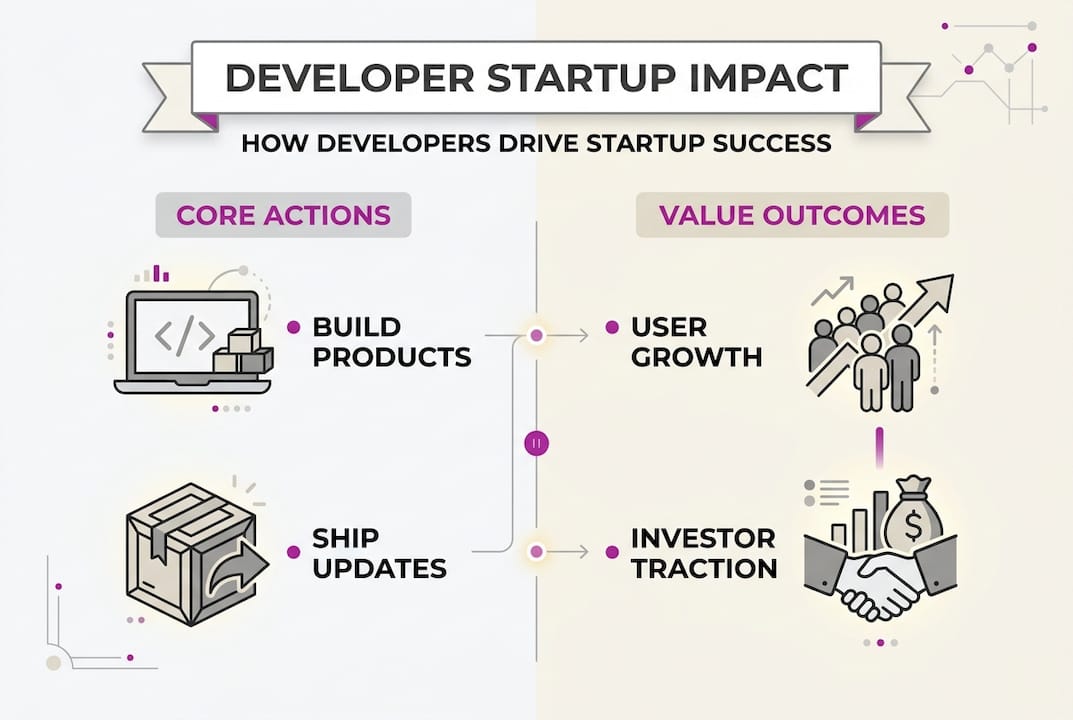
At the earliest stage, the best fit is often what Graham calls a brilliant but independent engineer. Someone who can make product decisions, write the code, ship, and adapt without needing a manager to translate business goals into technical tickets. This profile is rare, and it is worth paying attention to developer portfolios’ impact when evaluating candidates, since past shipped work tells you more than any interview.
Startups also offer developers something large companies cannot match: speed of learning, meaningful ownership, and real financial upside. That is the exchange. Developers take on risk and ambiguity; in return they get the chance to build something significant and share in what it becomes.
“A small group of people can build something that matters and make real money from it. The leverage is in the software.”
Key reasons developers drive outsized startup value:
- They reduce the time between idea and working product
- They make architectural decisions that shape scalability for years
- They often spot product problems before founders do
- WordPress for fast product launches illustrates how the right technical choice can compress months of build time into weeks
With the stage set on why the developer is so crucial, let us examine how the composition and hiring order of your initial engineering team sets the foundation for scale.
Building your founding development team: who, when, and why
The sequence of your early hires matters enormously. Get it wrong and you spend the first year translating between business and technical thinking, losing weeks to miscommunication on every sprint. Get it right and your product moves at a pace that surprises your competitors.

Hiring sequence research from a16z is clear: start with an Engineering Lead or CTO, then bring on two to four senior generalists. Avoid early managers or narrow specialists. This order is not arbitrary. Your first technical hire sets the cultural and architectural baseline for every engineer who follows.
Having a technical co-founder or strong early developer is not just convenient. Technical co-founders boost success rates by 160%, primarily because they eliminate the translation tax between product vision and technical execution. That tax is real. Every hour a non-technical founder spends trying to explain requirements, review code they cannot read, or second-guess technical choices is an hour the product is standing still.
Here is the recommended hiring sequence:
- Engineering Lead or CTO — sets technical direction and hires the rest
- Senior full-stack generalists — own entire features end-to-end
- Specialist contributors — added once the product surface is stable
- Engineering managers — only needed at 12 to 15 engineers
| Role | Hire when | Why it matters |
|---|---|---|
| CTO or Engineering Lead | Day one | Architectural ownership, team hiring |
| Senior generalist | Team of 2 to 5 | Full feature ownership, fast shipping |
| Specialist (e.g. data, security) | Product is stable | Depth where it is now needed |
| Engineering manager | 12 to 15 engineers | Coordination at scale |
Pro Tip: When recruiting technical talent, treat it like a sales process. Build a pipeline before you have an open role, lean on your network, and be explicit about the mission. The best developers have options. Mission and ownership close deals that salary alone cannot.
When you need to move fast on a custom SaaS team, resist the urge to hire generically. The wrong generalist hired too early can slow you down more than having no one at all.
Once you know who to hire, it is vital to understand how developers work best in the high-pressure, high-velocity environment of a startup.
Creating high-velocity engineering: principles and pitfalls
Speed is not a nice-to-have in early-stage startups. It is the product strategy. The faster you can ship, learn, and adjust, the more iterations you get before your runway runs out. This is why engineering culture in startups must be calibrated around velocity above almost everything else.
High velocity with technical debt correlates with better funding outcomes than clean, perfectly architected code that ships slowly. This is a surprising finding, but it makes sense when you think it through. Investors fund traction, not elegance. A scrappy codebase that has ten thousand users is more investable than a pristine one with ten.
YC’s engineering principles are worth studying: keep teams small, stay physically close to users, move fast, launch before you feel ready, and give developers full-stack ownership of features. These are not slogans. They are operationally precise choices that remove the friction between a developer having an idea and that idea reaching a user.
Key principles for high-velocity engineering:
- Prefer small pull requests shipped daily over large features shipped monthly
- Give developers context on business goals, not just technical tickets
- Treat technical debt as a conscious trade-off, not a failure
- Remove approval layers that add no value to the build cycle
Common pitfalls that kill engineering velocity:
| Pitfall | What it costs |
|---|---|
| Too many meetings | Context switching, lost flow state |
| Over-specified tickets | Developer autonomy crushed |
| Early code freezes | Slows feedback loops |
| Premature architecture | Locks decisions before you have data |
Pro Tip: If a developer is spending more than 20% of their week in meetings or waiting for approvals, your engineering culture has a structural problem, not a people problem.
Maintaining velocity is key, but rapid evolution in technology means the developer’s role is now being reshaped by AI.
How AI is changing the developer’s role in startups
In 2026, AI is not a future consideration for startup engineering teams. It is already reshaping what a developer does day-to-day. Founders who understand this shift can recruit more effectively and get more output from smaller teams.
AI boosts developer productivity by 20 to 100 percent or more depending on the task. The role is shifting from writing every line of code to planning, reviewing, and directing AI-generated output. Developers who are fluent in AI toolchains can effectively double their delivery speed on prototypes and routine features.
This has practical implications for founders:
- Favour developers who are comfortable with tools like Copilot, Cursor, and similar AI coding assistants. Check out best AI coding IDEs to understand what modern tooling looks like.
- Peer review processes need to evolve to account for AI-generated code, which can look correct but carry subtle logic errors
- Upskilling existing developers in AI workflows is cheaper and faster than replacing them
- AI-powered tools for startups can also extend product value without additional engineering headcount
Pro Tip: When hiring developers in 2026, ask candidates to walk you through a recent project where they used AI assistance. How they describe that process tells you far more about their judgement and adaptability than a whiteboard algorithm question.
The best developers are not threatened by AI tools. They use them the way a carpenter uses power tools. Speed goes up; craft still matters. If you want ultra-fast MVP development, pairing an experienced developer with the right AI stack is the most effective approach available today.
With these technology shifts in mind, there are several critical pitfalls and best practices for founders to consider as they build their developer teams.
Common mistakes and proven strategies for founders
Even founders who understand the importance of developers often make predictable mistakes when hiring and managing them. These patterns are worth naming clearly.
The most common error is hiring for skill without aligning on mission. A developer who does not believe in what you are building will leave at the first decent offer. Early-stage developers need to feel ownership, not just employment. Equity, autonomy, and genuine influence over product decisions are what retain strong engineers when you cannot match corporate salaries.
The a16z advice on recruiting like a sales process is directly applicable here. Build a pipeline, stay in contact with strong developers even when you have no role open, and be honest about the company’s stage and challenges. Developers talk to each other. A reputation for transparency is a recruiting asset.
“The best developers do not take jobs. They choose missions.”
Proven strategies for founders:
- Offer meaningful equity — not token amounts that signal you do not value the contribution
- Share context freely — developers make better decisions when they understand the business goals
- Delay process until it is needed — structure is a cost, not a benefit, in teams under ten
- Celebrate shipping — acknowledge delivery, not just planning
- Avoid the manager reflex — hiring a manager to fix a culture problem rarely works
For external developer recruitment, the same principles apply. Contractors and freelancers respond to clarity of brief, speed of decision-making, and fair terms. Treat them as partners and you get partner-level output.
Having examined common mistakes and their solutions, it is time to offer a perspective that cuts through much of the received wisdom about developers in startups.
Why the ‘perfect’ developer doesn’t exist—and what founders should seek instead
The startup world has a fixation on the mythical 10x developer. Founders spend months searching for a singular genius who will build everything, break nothing, and somehow also explain the codebase to investors. That search is usually a distraction.
In practice, the developers who create the most value in startups are not always the most technically brilliant people available. They are the ones who care about the problem, communicate clearly, adapt when the product pivots, and take genuine ownership of outcomes. Those qualities are not rare in the way technical genius is. They can be found, and more importantly, they can be cultivated through the right working environment.
What founders should actually evaluate is alignment: does this developer understand what success looks like for the business? Are they motivated by the mission or just the technical challenge? Do they have the range to make sensible product decisions when needed, not just clean code decisions?
Reviewing developer portfolios and past client outcomes gives you far more signal on these qualities than any technical assessment. Real leverage in a startup comes from enabling capable, motivated developers to do their best work. Not from finding a unicorn.
How to get the developer advantage for your startup
Building the right technical foundation early is one of the highest-leverage decisions a startup founder makes. Whether you need a technical lead to own your architecture, a full-stack developer to accelerate an MVP, or a senior engineer to audit and strengthen what you have already built, the right developer partner changes the trajectory.
Rich Harrington brings over 22 years of full-stack experience to startups that need reliable, senior-level development without the overhead of a full agency. From custom SaaS development to rapid product builds and technical strategy, the work is scoped to your stage and goals. If you are ready to move faster and build smarter, book a consultation and get a clear technical roadmap built around your specific needs.
Frequently asked questions
Do all startups need a technical co-founder?
Not always, but technical co-founders increase success rates by 160% by enabling faster iteration and tighter product-market fit. A strong senior developer hired early can provide similar advantages if equity and ownership are structured well.
Is it better for early-stage startups to prioritise speed or clean code?
Speed and user feedback come first. High velocity with technical debt consistently correlates with better funding outcomes, so treat code quality as something you invest in once you have validated your product.
How is AI changing what developers do in startups?
AI lifts developer productivity by 20 to 100 percent or more, shifting focus from writing every line to planning, reviewing, and directing AI output. Hiring should now prioritise developers who are fluent in AI-assisted workflows.
When should a startup hire engineering managers or specialists?
Hold off until your engineering team reaches 12 to 15 people before adding managers. Adding them too early removes the ownership and autonomy that make small developer teams effective.
Recommended
- How WordPress empowers startups to launch and scale | Rich Harrington
- Why a great developer portfolio brings clients to your door | Rich Harrington
- Custom SaaS Development | Rich Harrington - Full-Stack Developer
- Services | Rich Harrington - Full-Stack Developer
- IT Support Engineer – The Backbone of Brisbane SMEs - IT Start