Discover how effective developer communication and psychological safety drive project success, with practical strategies for business owners and project managers.
Project success: developer communication drives 27% gains

TL;DR:
- Psychological safety is the key predictor of high-performing developer teams.
- Effective communication fosters faster learning, better stakeholder engagement, and fewer surprises.
- Building trust and open feedback culture is more impactful than adding tools or meetings.
Hiring the sharpest developers on the market feels like a guaranteed path to project success. It makes sense on paper. But psychological safety ranks #1 as the defining factor in high-performing teams, ahead of individual talent, tools, or process. Google’s Project Aristotle studied hundreds of internal teams and found that how people communicate matters far more than who is in the room. This guide breaks down why communication is the real engine behind successful development projects, and gives you practical strategies to build it into your team from the ground up.
Table of Contents
- Why communication matters more than talent in developer teams
- Core elements of effective developer communication
- Common barriers and pitfalls in developer communication
- Best practices for cultivating trust and open feedback
- Our perspective: why project tools and standups miss the bigger picture
- Take your developer communication to the next level
- Frequently asked questions
Key Takeaways
| Point | Details |
|---|---|
| Communication trumps skill | Effective developer communication has a bigger impact on project outcomes than technical ability alone. |
| Build psychological safety | Teams that feel safe to share and learn outperform others by wide margins. |
| Embrace feedback loops | Frequent, open feedback enables innovation and prevents costly mistakes. |
| Adapt for remote work | Asynchronous tools and clear updates are crucial for distributed developer teams to collaborate well. |
Why communication matters more than talent in developer teams
Most business owners and project managers chase the same goal: find the best developers and let them build. It is a reasonable instinct. But talent alone does not guarantee delivery. Projects stall, requirements drift, and stakeholders disengage, not because the developers lack skill, but because information is not flowing freely.
Google’s Project Aristotle is the clearest evidence we have. After analysing 180 teams, researchers found that the single biggest predictor of team performance was not technical expertise or seniority. It was psychological safety, the degree to which team members feel safe to take risks, ask questions, and admit mistakes without fear of embarrassment or punishment.
The numbers are hard to ignore. Teams with high psychological safety outperform their counterparts by 27%. That is not a marginal gain. It is the difference between a project that ships on time and one that quietly unravels over several sprints.
“The highest-performing teams are not defined by who is on them, but by how openly and safely they communicate with one another.”
When developers feel safe to speak up, the whole project ecosystem benefits. Consider what open communication actually produces in practice:
- Faster learning curves as developers share blockers and solutions without hesitation
- Stronger stakeholder engagement because updates are honest rather than polished to avoid conflict
- Fewer late-stage surprises as problems surface early instead of compounding silently
- Repeated project wins driven by teams that learn from each iteration rather than repeat the same mistakes
A technically brilliant developer who hoards knowledge or avoids difficult conversations will consistently underperform a slightly less experienced developer who communicates clearly and asks for help when needed. The value a developer brings to clients is never purely about code. It is about trust, clarity, and the ability to keep everyone aligned throughout a project.
This is the core shift worth making. Stop optimising purely for technical credentials and start building environments where communication is rewarded, modelled, and protected.
Core elements of effective developer communication
Knowing that communication matters is one thing. Knowing what good communication actually looks like in a development team is another. The gap between those two things is where most projects run into trouble.
Agile methodologies are built around frequent feedback. Short sprints, retrospectives, and daily check-ins are all designed to surface information quickly so teams can adapt. Traditional, specification-driven approaches take the opposite view: define everything upfront and build to the spec. In reality, agile practices favour frequent feedback while waterfall models rely on detailed documentation, and the data consistently favours the adaptive approach for complex projects.
One of the most practical decisions you can make is how your team communicates day to day. Asynchronous and synchronous methods each have their place, and mixing them thoughtfully makes a real difference.
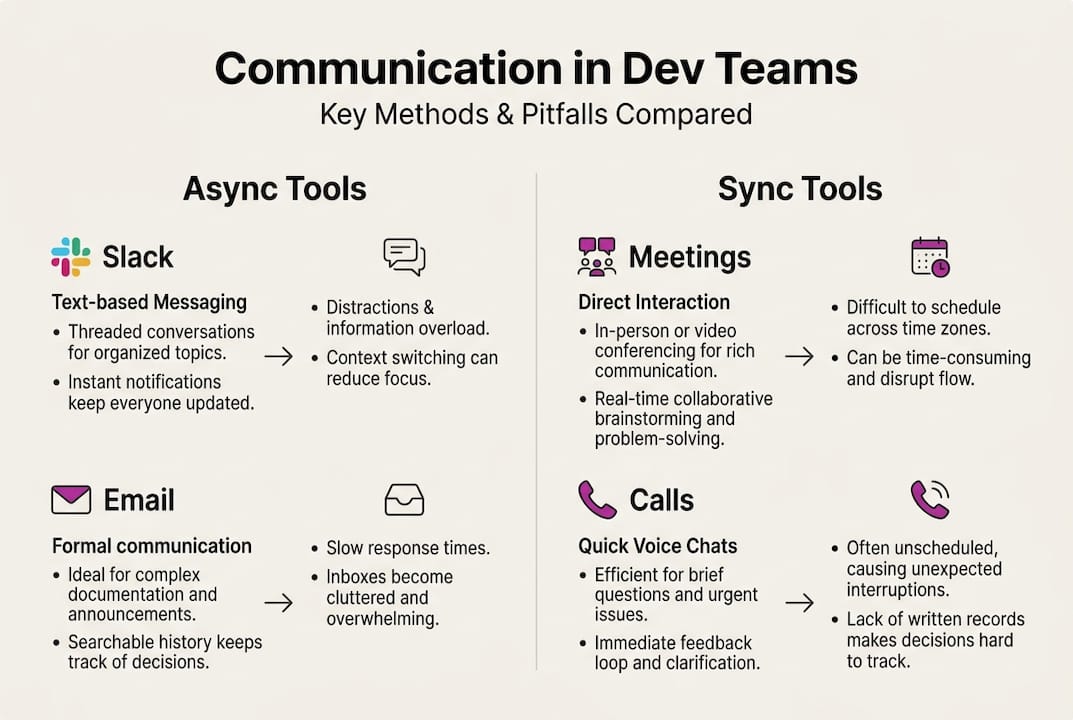
| Method | Benefits | Pitfalls |
|---|---|---|
| Asynchronous (Slack, email, docs) | Reduces interruptions, creates a written record, suits remote teams | Slower decisions, easy to misread tone, can create information silos |
| Synchronous (calls, standups, pair programming) | Fast decisions, builds rapport, resolves ambiguity quickly | Meeting fatigue, excludes those in different time zones, no automatic record |
Neither method wins outright. The teams that communicate best use async for context and updates, and synchronous for decisions and unblocking.
Building psychological safety does not happen by accident. Here is a practical framework you can apply with any team:
- Model the behaviour yourself. Ask questions openly. Admit when you do not know something. If you are the most senior person in the room, your willingness to be vulnerable sets the tone for everyone else.
- Normalise learning from mistakes. Run lightweight retrospectives after each sprint or milestone. Frame errors as data, not failures.
- Reward questions, not just answers. Publicly acknowledge when someone flags a problem early or asks a clarifying question that saves the team time.
- Set clear communication norms. Agree on response time expectations, where decisions get documented, and how urgent issues get escalated.
Pro Tip: Decision latency often matters more than tool selection. The question is not whether you use Slack or Teams, it is how quickly your team can make a call and adapt when something changes. Faster decisions compound over a project. If you want tech consulting support to audit your team’s communication setup, that is a worthwhile starting point.
Common barriers and pitfalls in developer communication
Even teams with the best intentions run into communication breakdowns. Recognising the patterns early means you can address them before they cost you a sprint or a client relationship.
The most common blockers look like this:
- Jargon and assumed knowledge that excludes non-technical stakeholders from meaningful conversations
- Unspoken expectations where developers assume requirements are clear and stakeholders assume developers will ask if they are not
- Information hoarding where knowledge lives in one person’s head rather than shared documentation
- Unclear or outdated documentation that teams quietly stop trusting and start working around
- Status updates designed to reassure rather than inform, which mask real problems until they become crises
Remote-first teams face an additional layer of complexity. Without the informal corridor conversations that surface problems naturally, you need structure to replace them. Structured async communication over meetings is essential for distributed teams, but it requires discipline. A daily written update or a shared project board only works if everyone contributes consistently and honestly.
Tool choice is a distraction from the real issue. Teams that communicate poorly will communicate poorly on Slack, on Jira, and in person. The problem is almost never the platform. It is the habits and norms that surround it. You can see how structured communication plays out in real projects by looking at examples like B2B collaboration builds and client-facing project work, where clarity between all parties drove better outcomes.
Pro Tip: Schedule regular feedback checkpoints, even for async teams. A brief fortnightly session where the team can raise concerns openly will surface issues that written updates never capture. Treat it as a standing agenda item, not an optional extra.
Best practices for cultivating trust and open feedback
Building a culture of open communication is not a one-off initiative. It requires consistent, deliberate action from everyone in a leadership or management position. Here is what that looks like in practice.

| Element | What good looks like | What to avoid |
|---|---|---|
| Check-in frequency | Weekly one-to-ones plus team retrospectives | Monthly reviews with no structured touchpoints |
| Feedback channels | Anonymous options alongside direct conversations | Only public channels where people fear judgement |
| Recognition | Public praise for openness and early problem-flagging | Only rewarding outputs, never behaviours |
| Response rates | Leaders respond to questions within 24 hours | Questions left unanswered signal that raising them was not worth it |
If you want to move from intention to action, follow these steps:
- Audit your current norms. Ask your team directly: do you feel safe raising concerns? The answers will tell you more than any process review.
- Create a feedback ritual. A short retrospective at the end of each sprint or project phase builds the muscle over time.
- Invite cross-functional input. Bring stakeholders into conversations earlier. Developers who understand business context make better technical decisions.
- Reward the signal, not just the solution. When someone flags a risk early, acknowledge it. That behaviour is worth more than a last-minute fix.
- Document decisions openly. When people can see how and why decisions were made, trust builds naturally.
Teams scoring high on psychological safety win more often and innovate faster. The long-term impact is significant: less rework, more satisfied stakeholders, and development cycles that improve with each iteration. Pairing these practices with scalable project workflows gives you the operational backbone to sustain that momentum. For teams that want a structured approach, technical consulting can help you map communication gaps to specific project outcomes. You can also look at security and infrastructure practices as part of a broader DevOps culture that supports team transparency.
Our perspective: why project tools and standups miss the bigger picture
Here is something most project management advice will not tell you: adding more tools and more meetings to a team that lacks trust will make things worse, not better. Every new Slack channel or daily standup creates the illusion of communication without the substance of it.
The uncomfortable truth is that psychological safety cannot be installed. It is earned through consistent behaviour over time. A team that fears blame will use every tool available to cover their tracks rather than surface problems. A team that trusts each other will communicate clearly even with minimal tooling.
The analogy that holds up is this: a standup meeting in a low-trust team is theatre. Everyone reports green, nothing gets raised, and the real issues get discussed in private messages afterwards. The ritual exists, but the communication does not.
True progress happens when feedback is safe, not just frequent. We have seen this play out repeatedly across projects where the portfolio demonstrates real client trust. The projects that delivered well were not the ones with the most sophisticated tooling. They were the ones where everyone felt comfortable saying “this is not working” before it became a crisis.
Invest in the culture first. The tools will follow.
Take your developer communication to the next level
If this article has surfaced gaps in how your team communicates, the good news is that they are fixable. The strategies above are practical and proven, but applying them to your specific team, project type, and stakeholder mix takes a clear-eyed audit and a plan.
Rich Harrington works directly with business owners and project managers to close the gap between technical delivery and business outcomes. Whether you need a full overview of available services, a custom SaaS solution built with communication baked in from day one, or simply a conversation about where your current setup is falling short, the starting point is straightforward. Book a discovery call and get a clear picture of what better developer communication looks like for your team.
Frequently asked questions
What is psychological safety and why does it matter in developer teams?
Psychological safety means team members feel comfortable speaking up, sharing ideas, and admitting mistakes without fear of judgement. High-safety teams outperform others by 27%, making it one of the most measurable levers in project performance.
What is the best way to encourage feedback from developers?
Schedule regular check-ins, offer anonymous channels for suggestions, and publicly reward openness so that sharing feedback feels like a normal and valued part of the team’s culture.
Do remote developer teams need different communication strategies?
Yes. Structured async communication and clear documentation are essential for distributed teams, replacing the informal conversations that naturally surface issues in co-located settings.
Can communication really outweigh technical skill for project success?
Effective communication and trust consistently drive better project outcomes than technical skill alone, as Google’s research confirms that team dynamics matter more than individual credentials.
Recommended
- Why a great developer portfolio brings clients to your door | Rich Harrington
- Rich Harrington | Full-Stack Developer & WordPress Expert
- Services | Rich Harrington - Full-Stack Developer
- Custom SaaS Development | Rich Harrington - Full-Stack Developer
- Team capacity planning: 40% more story points delivered | Teambuilt Blog
- Best Practices: Project Management